
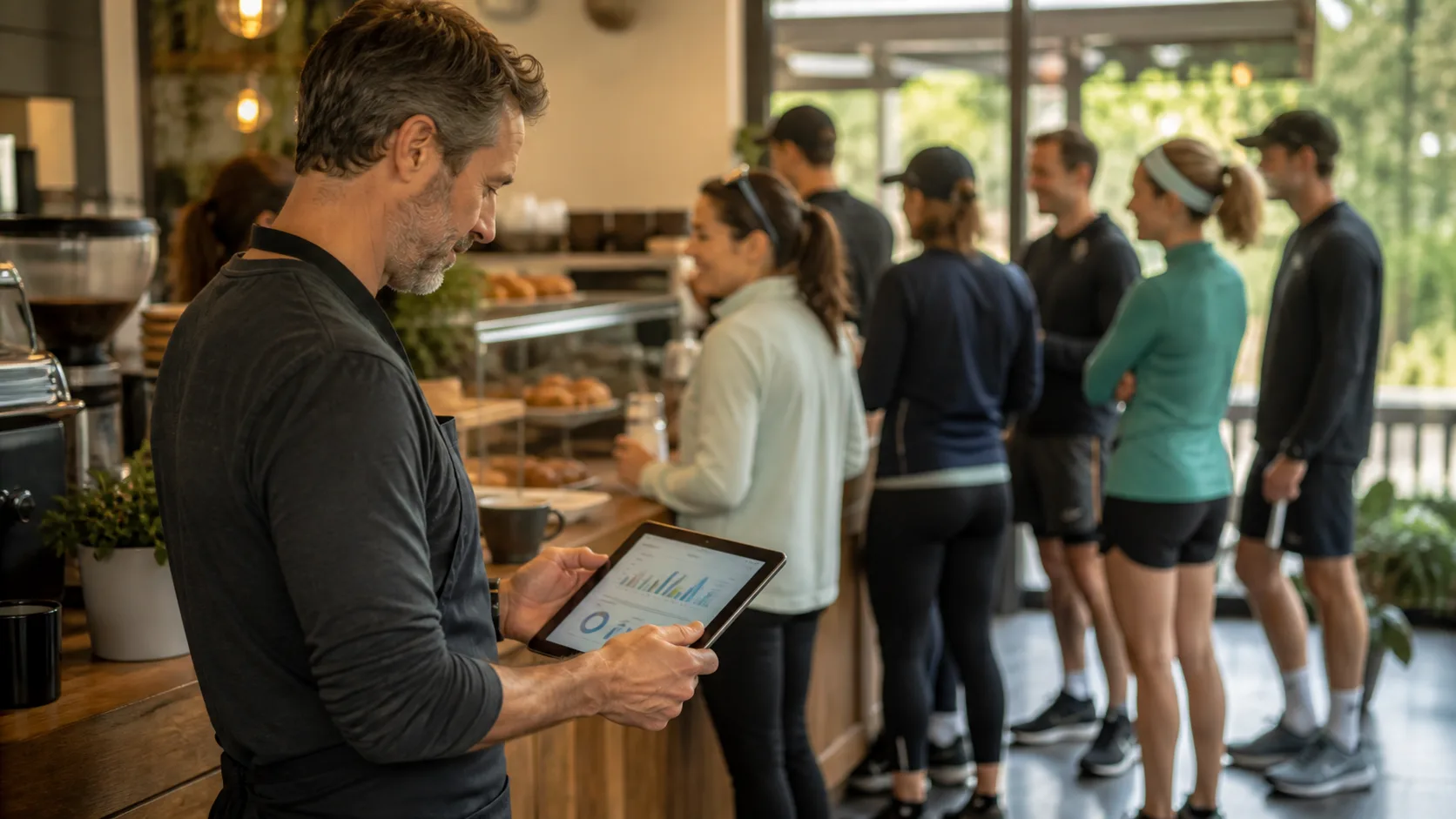
A run club can increase cafe revenue if it brings additional, profitable visits without displacing higher-value customers or creating excessive service costs. Attendance alone does not prove that. The cafe needs a before-and-after baseline, a way to identify runner transactions and a view of repeat visits.
The first goal is not a perfect attribution system. It is a consistent four-week test that answers whether the partnership deserves more time.
Which numbers should the cafe record?
| Measure | What it tells you |
|---|---|
| Verified club attendance | How many runners actually took part |
| Runner transactions | How many attendees bought something |
| Runner revenue | Sales linked to those transactions |
| Reward cost | Actual cost of discounts or free items |
| Service impact | Queue time, staffing pressure and complaints |
| Repeat visits | Whether runners return outside the club session |
Use RunClub check-ins for attendance rather than relying on RSVPs. An RSVP describes intention. A check-in describes participation. The article on club check-ins explains the distinction.
How do you create a fair baseline?
Record the same day and time window for several comparable weeks before the pilot. Note unusual conditions such as a bank holiday, major local event, severe weather or road closure. Then compare the run club sessions with that baseline.
A simple change calculation is:
Incremental revenue = pilot-window revenue minus comparable baseline revenue.
Revenue is not profit. Subtract the direct cost of the runner offer, additional staffing and other incremental costs to estimate contribution. If normal customers leave because the queue is too long, record that too. The result should reflect the whole trading window, not only the till receipts labelled as runners.
How do you identify runner transactions?
Create a dedicated till button or code for the partnership, even if the offer has no discount. Staff can apply it when a runner presents valid verification. That creates a consistent transaction count without collecting unnecessary personal data.
Do not hand the venue a club member list. If either party wants to send marketing, it should follow the ICO's direct marketing guidance, including transparency, a valid lawful basis and respect for opt-outs.
RunClub's verified deals can connect the member benefit to the club experience without turning the partnership into a shared spreadsheet of customer details.
What does a useful four-week report look like?
Keep it to one page. Show each session's attendance, runner transactions, revenue, offer cost and operational notes. Add the baseline for the same time window and a total for the pilot. End with one recommendation: continue unchanged, change one variable, or stop.
Do not hide a weak result behind social impressions. A post can receive attention without creating a manageable customer visit. Equally, a small group of regular buyers may be commercially stronger than a large launch event.
How can the cafe improve the result?
Change the constraint the data reveals. If few attendees buy, test a clearer or more relevant bundle. If orders are healthy but service struggles, pre-batch suitable items, change the arrival time or cap attendance. If the venue is already full, shift the run to a quieter slot rather than increasing the discount.
The run club rewards guide helps match an offer to a business goal. The route creator can also help organisers adjust the finish so runners arrive at an agreed point.
How should the cafe calculate partnership ROI?
Use a transparent calculation rather than assigning a cash value to every social post. One practical version is:
Partnership ROI = (incremental contribution minus partnership cost) divided by partnership cost.
Incremental contribution is the extra revenue attributable to the pilot after the direct cost of products sold. Partnership cost can include the reward, extra staffing, printed materials and any fee. If the cost is zero, report the incremental contribution instead of forcing a percentage from a zero denominator.
Keep assumptions beside the result. If repeat visits cannot yet be identified, report them as unknown rather than estimating them. A cautious result that the manager trusts is more valuable than an impressive figure built on guesses.
What is a good conversion rate from runners to buyers?
There is no universal benchmark that applies across formats, prices and times. Establish the venue's own baseline during the pilot, then improve it without harming margin or service.
Should social media exposure count as revenue?
No. Record relevant reach separately, but do not convert impressions into invented sales. Revenue, transactions, redemptions and repeat visits are stronger commercial measures.
How do you measure repeat visits?
Use a later-visit reward or privacy-conscious till code with a defined expiry. Measure aggregate redemptions. Do not identify or contact individuals without the appropriate information and lawful basis.
Where can a cafe begin a partnership?
Review RunClub for venues, choose one nearby club and propose a controlled four-week pilot. Agree the measurement before the first event so both sides define success in the same way.